


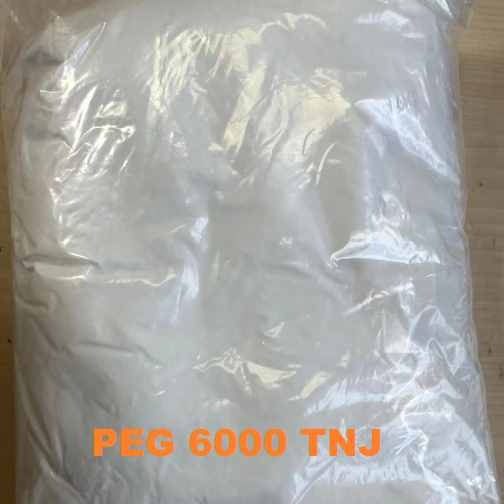
Product name: Polyethylene Glycol 6000 (PEG 6000)
Average molecular weight: 5400–7800
Category: Non-ionic polyether polymer
CAS Number: 25322-68-3
Physical and Chemical Properties of Polyethylene Glycol 6000 (PEG 6000)
Appearance: White waxy solid granules/powder at room temperature
Melting point range: 58–63 ℃
Viscosity: 1700–2200 mPa·s (60℃)
Solubility: Easily soluble in water and hot water; soluble in ethanol and acetone; insoluble in hydrocarbons and mineral oil.
Hygroscopicity: High molecular weight, much less hygroscopic than PEG400 and PEG600 liquid series.
Chemical characteristics: Stable at room temperature, not easily hydrolyzed; hydroxyl groups at both ends can undergo esterification and etherification; can oxidatively decompose at temperatures above 200℃.
5% aqueous solution pH: 4.0–7.5
Main Uses of Polyethylene Glycol 6000 (PEG 6000)
1. Pharmaceutical Industry (Pharmaceutical Grade PEG6000)
Tablet and capsule binders, lubricants (for dry compression, reducing tablet sticking);
Solid drug dispersion carriers to improve the dissolution of poorly soluble drugs;
Suppository base component;
Ointment and sustained-release formulation excipient.
2. Personal Care / Cosmetics
Thickener and moisturizing aid in creams and cleansing products; dispersant in makeup; improve formulation stability; often blended with low molecular weight PEG to adjust skin feel.
3. Industrial Applications
Lubricant and release agent in rubber and plastic processing;
Paper and textile sizing, antistatic agent;
Brighteners and dispersants in electroplating;
Raw material for organic synthesis, used to synthesize PEG ester surfactants;
Dispersing aid for ceramics and pigments.
4. Food Industry (Food Grade)
Complies with GB2760, used as food release agent, flavor carrier, and processing aid.
Safety Information
Low toxicity, not considered a hazardous chemical; non-corrosive and non-flammable under normal conditions
Very low skin irritation; avoid inhaling large amounts of powder
Important Reminders
Do not bake at high temperatures for long periods, as high-temperature oxidation can produce irritating aldehydes;
Do not store with strong oxidizers;
Large oral intake can cause diarrhea.
Storage Conditions
Store in a sealed, cool, dry, and ventilated place; keep away from heat sources; prevent moisture and clumping; avoid direct sunlight.
Simple Comparison for Reference
PEG400/600: Liquid, high moisturizing, solubilizer
PEG1000/1500: Low melting waxy substances
PEG6000: High melting solid, mainly used for solid tablets, lubrication/release, and thickening
Specification
Type |
Appearance (25Co) |
Color (Pt-Co) max |
Hydroxyl value (mgKOH/g) |
M.W. |
pH |
PEG 200 |
Colorless liquid |
40 |
510-623 |
180-220 |
5.0-7.0 |
PEG 300 |
Colorless liquid |
40 |
340-416 |
270-330 |
5.0-7.0 |
PEG 400 |
Colorless liquid |
40 |
255-311 |
360-440 |
5.0-7.0 |
PEG 600 |
Colorless liquid |
40 |
170-208 |
540-660 |
5.0-7.0 |
PEG 800 |
White paste |
40 |
127-156 |
720-880 |
5.0-7.0 |
PEG 1000 |
White paste |
40 |
102-125 |
900-1100 |
5.0-7.0 |
PEG 1500 |
White solid |
40 |
68-84 |
1350-1650 |
5.0-7.0 |
PEG 2000 |
White flake |
50 |
51-63 |
1800-2200 |
5.0-7.0 |
PEG 3000 |
White flake |
50 |
34-42 |
2700-3300 |
5.0-7.0 |
PEG 4000 |
White flake |
50 |
26-32 |
3600-4400 |
5.0-7.0 |
PEG 6000 |
White flake |
50 |
16-21 |
5400-7000 |
5.0-7.0 |
PEG 8000 |
White flake |
50 |
12-16 |
7200-8800 |
5.0-7.0 |
Packing
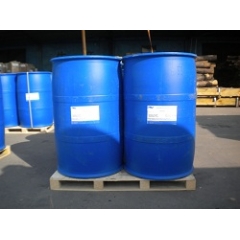
PEG200-1000: Iron or plastic barrel. Net weight 50Kg, 200Kg.
PEG2000-8000: Plastic woven bag lined with plastic bag or compound bag. Net weight 25kg.

 chemical.tnj
 +8618949823763
 tnjchem
 2881500864