


How to Distinguish the Grades of Animal Oleic Acid
Chinese manufacturers commonly classify animal oleic acid by congealing point grades Y-4 / Y-8 / Y-10 (the most mainstream classification method). It is further graded by oleic acid (C18:1) content, color and purity. A key characteristic of animal oleic acid: iodine value generally ranges from 80–100 (much lower than 110–135 for vegetable oleic acid)
1. Basic Grades (Classified by Congealing Point, Most Widely Used in China)
| Grade | Congealing Point ≤℃ | Iodine Value gI₂/100g | Acid Value mgKOH/g | Saponification Value mgKOH/g | Moisture ≤% | Color (Hazen) ≤ | Application Scenarios |
|---|---|---|---|---|---|---|---|
| Y-4 | 4 | 80–95 | 190–203 | 190–205 | 0.5 | 400 | Low-temperature working conditions, cutting fluids, high-end emulsifiers (low tendency to solidify) |
| Y-8 | 8 | 80–100 | 190–203 | 190–205 | 0.5 | 400 | General mainstream grade (metal rust inhibitors, leather fatliquoring agents, plastic additives, most commonly used for foreign trade) |
| Y-10 | 10 | 80–100 | 185–203 | 185–205 | 0.5 | 400 | Low-cost basic grade, no requirement for low-temperature fluidity |
2. Graded by Purity (C18:1 Oleic Acid Content, Increasingly Adopted for Export COA)
1) Regular Industrial Animal Oleic Acid: C18:1 ≥70% (Most Y4/Y8/Y10 products on the market fall into this grade)
2) High-Purity Animal Oleic Acid: C18:1 ≥78%~82%, lighter color (≤200 Hazen), fewer impurities, suitable for fine synthesis and daily chemicals
3) Refined & Decolorized Grade: C18:1≥78%, color ≤150 Hazen, low odor
3. Other Classification Dimensions
Raw Material Source: Lard-based animal oleic acid / tallow-based animal oleic acid (tallow contains higher saturated fatty acids and has a higher congealing point)
Refining Degree: Crude grade (dark color, strong odor) / Refined grade (deodorized and decolorized)
Special Grades:
Feed-grade animal oleic acid (with limits on microorganisms and heavy metals)High-purity separated grade (C18:1≥90%, high price, rarely stocked as regular goods)
4. Animal Oleic Acid VS Vegetable Oleic Acid (Critical for Foreign Trade to Avoid Customer Confusion)
Animal Oleic Acid: Iodine value 80–100, high saturated fatty acid content, relatively low congealing point
Vegetable Oleic Acid: Iodine value 110–135, high linoleic acid content
5. Suggestions for Order Placement & COA Marking for Export (Directly Applicable)
Standard export description: Animal Oleic Acid, Grade Y-8, C18:1 ≥78%
Mandatory core indicators to state: Congealing Point, Iodine Value, Acid Value, Moisture, Color, C18:1 Content6. Supplementary Notes
The current light industry standard QB/T 2153-2022 no longer mandates the Y-series naming convention, and directly classifies products as high-purity oleic acid / regular industrial oleic acid. Nevertheless, domestic oil & fat manufacturers and traders still widely use the Y-4/Y-8/Y-10 designation.
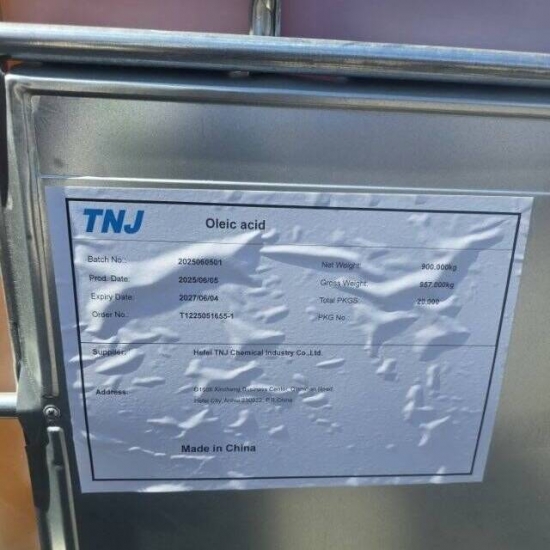
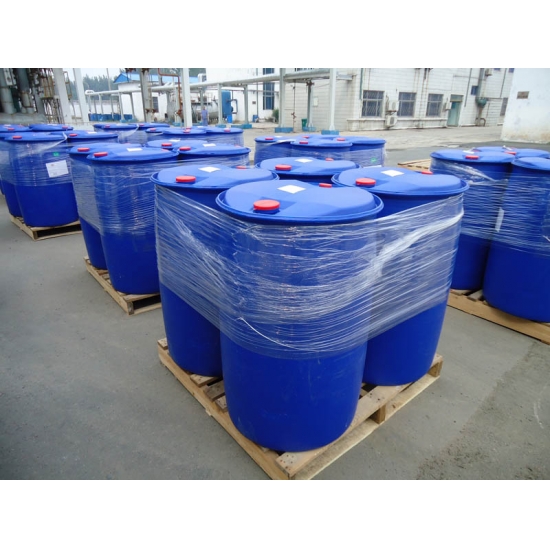
Package
180kg/drum, 80drums per 20GP container
Storage and handling
Keep tightly closed, store in a cool dry place.
Please refer to the Materials Safety Data Sheet (MSDS) for the handling methods.
 chemical.tnj
 +8618949823763
 tnjchem
 2881500864